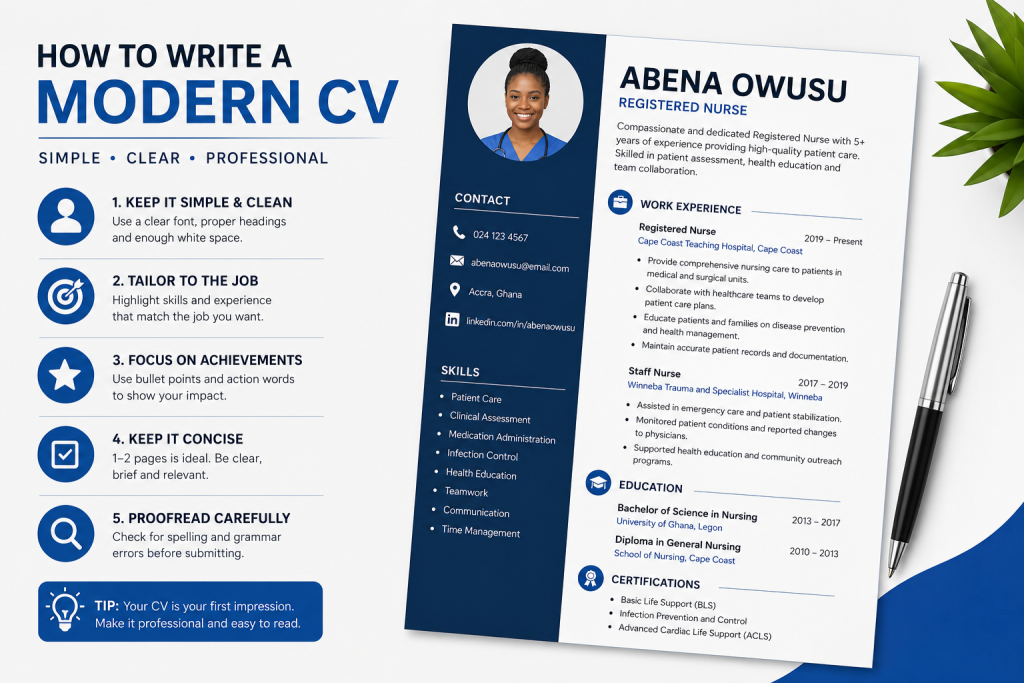
In today's competitive job market, a well-written, modern CV can significantly increase your chances of being shortlisted for an interview. It is often the first impression a potential employer has of you.
Unlike older CV formats that contained unnecessary personal details and lengthy descriptions, modern CVs are concise, well-organized, tailored to the job, and focused on achievements rather than simply listing responsibilities.
What Is a Modern CV?
A modern CV is a professional document that highlights your education, work experience, skills, achievements, and qualifications in a clear and easy-to-read format. It is usually one to two pages long, depending on your level of experience.
The goal is to quickly show employers why you are the best candidate for the position.
Essential Sections of a Modern CV
1. Personal Information
Include only relevant contact details such as:
- Full name
- Phone number
- Professional email address
- City or town of residence
- LinkedIn profile (if available)
- Professional portfolio or website (if applicable)
Avoid including:
- Date of birth (unless specifically requested)
- Marital status
- Religion
- Tribe or ethnicity
- Height and weight
- Nationality (unless required)
- Names of parents
2. Professional Summary
Write a short paragraph of three to five lines summarizing who you are, your experience, and what you can offer an employer.
Example:
"Dedicated Registered General Nurse with over eight years of clinical experience providing quality patient care in medical, surgical, and infectious disease units. Strong communication, leadership, and patient education skills with a passion for preventive healthcare."
3. Work Experience
List your work experience starting with the most recent position.
Include:
- Job title
- Employer
- Location
- Dates of employment
- Key achievements and responsibilities
Instead of writing:
- Responsible for patient care.
Write:
- Managed care for up to 30 patients per shift while maintaining accurate documentation and collaborating with multidisciplinary healthcare teams.
- Educated patients on disease prevention and medication adherence.
Use action verbs such as:
- Managed
- Coordinated
- Led
- Implemented
- Improved
- Developed
- Achieved
- Supervised
4. Educational Background
List your qualifications from the most recent.
Example:
- Bachelor of Science in Nursing
- Diploma in Nursing
- Senior High School Certificate
Include:
- Institution
- Qualification
- Year completed
5. Professional Skills
Employers often scan this section first.
Examples include:
- Communication skills
- Leadership
- Teamwork
- Critical thinking
- Time management
- Computer literacy
- Microsoft Office
- Data analysis
- Customer service
- Problem-solving
For healthcare professionals:
- Patient assessment
- Infection prevention and control
- Emergency care
- Medication administration
- Health education
6. Certifications and Professional Development
Include relevant certificates such as:
- Basic Life Support (BLS)
- Advanced Cardiac Life Support (ACLS)
- Infection Prevention and Control
- Occupational Safety
- Project Management
- Digital Marketing
- Data Analytics
7. Achievements
Highlight measurable accomplishments.
Examples:
- Reduced patient waiting time through improved workflow.
- Led a successful health education campaign.
- Received Employee of the Month recognition.
- Published articles or books in your field.
8. Volunteer Experience
Volunteer work demonstrates initiative and community involvement.
Examples:
- Health outreach programmes
- NGO activities
- Community education
- Youth leadership roles
9. References
Modern CVs no longer require listing references unless specifically requested.
Instead, simply write:
References available upon request.
Formatting Tips for a Modern CV
To make your CV professional:
- Use a clean font such as Calibri, Arial, Aptos, or Times New Roman.
- Font size should generally be 10–12 points for the main text.
- Use bold headings.
- Leave enough white space.
- Keep margins consistent.
- Save the document as a PDF before sending it unless another format is requested.
- Tailor your CV for each job application by emphasizing the most relevant experience and skills.
Common Mistakes to Avoid
Many applicants lose opportunities because of avoidable errors.
Avoid:
- Spelling and grammatical mistakes
- Long paragraphs
- Including irrelevant personal information
- Using an unprofessional email address
- Submitting the same CV for every job
- Providing inaccurate or misleading information
- Poor formatting and inconsistent fonts
Final Thoughts
A modern CV is more than a list of qualifications—it is a marketing document that showcases your value to an employer. Keep it concise, relevant, and tailored to the role you are applying for. Regularly update your CV with new skills, certifications, and achievements to ensure it reflects your latest professional experience.
It is important to invest time in making one’s CV accurate, professional, and easy to read as it offers the first impression about an applicant and determines if he or she would be called for an interview or not.