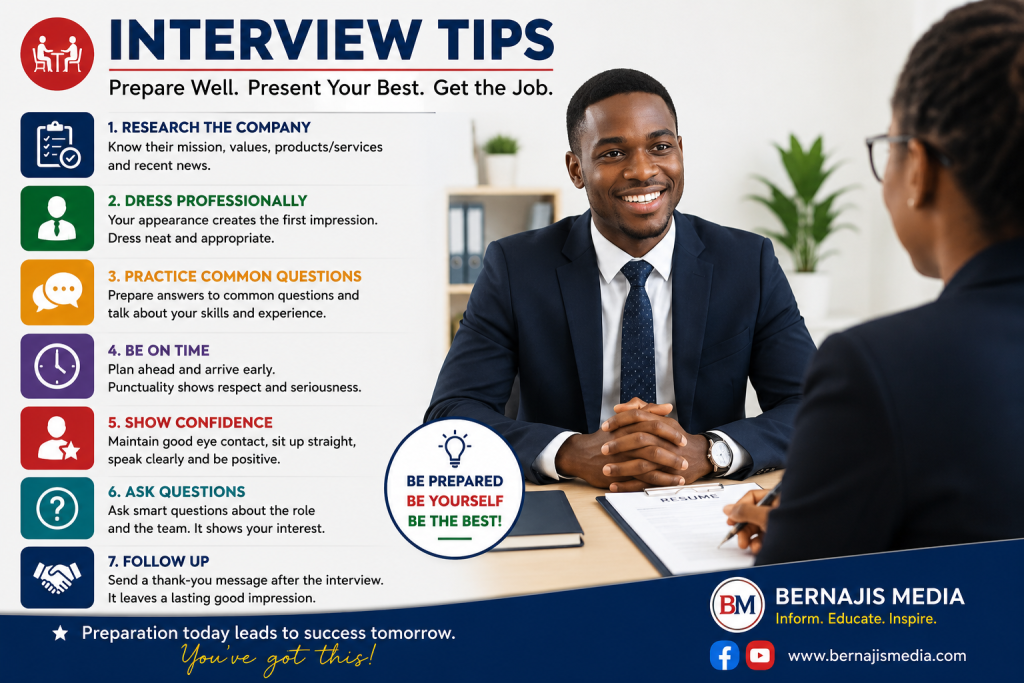
An invitation for a job interview is a valid indication that your CV offered good impression about you to your potential employers. However, your performance during the interview is the ultimate test that determines if you would get the job among many competitors who had the same opportunity.
Many qualified applicants lose opportunities not because they lack knowledge, but because they fail to prepare adequately. The good news is that interview skills can be learned and improved.
Why Interviews Matter
Employers use interviews to assess more than your qualifications. They want to determine whether you have the communication skills, confidence, professionalism, and attitude needed to succeed in the role.
A good interview allows you to demonstrate why you are the best candidate beyond what is written in your CV.
1. Research the Employer
Before attending an interview, learn about the organisation.
Find out:
- What the organisation does.
- Its mission and values.
- The services or products it provides.
- Recent achievements or news.
- The specific role you applied for.
Employers appreciate candidates who understand their organisation.
2. Understand the Job Description
Read the job advertisement carefully.
Be prepared to explain:
- Why you are interested in the position.
- How your skills match the role.
- What experience makes you suitable.
Use examples from your education, work experience, internships, or volunteer activities.
3. Practise Common Interview Questions
Some questions appear in many interviews.
Examples include:
- Tell us about yourself.
- Why do you want this job?
- What are your strengths?
- What is one area you are working to improve?
- Why should we hire you?
- Where do you see yourself in five years?
- Tell us about a challenge you overcame.
Practising your responses helps you communicate clearly and confidently without sounding memorised.
4. Dress Professionally
Your appearance creates a first impression.
Choose neat, clean, and appropriate clothing.
For most professional interviews:
- Wear well-ironed clothing.
- Avoid excessive jewellery or perfume.
- Keep your hairstyle neat.
- Wear clean shoes.
- Maintain good personal hygiene.
Dress slightly more formally than the organisation's everyday dress code if you are unsure.
5. Arrive Early
Plan to arrive at least 15 to 30 minutes before the interview.
Arriving early:
- Reduces stress.
- Gives you time to settle.
- Demonstrates punctuality and reliability.
If the interview is online, test your internet connection, microphone, camera, and device beforehand.
6. Maintain Good Body Language
Your non-verbal communication is just as important as your words.
Remember to:
- Smile naturally.
- Maintain appropriate eye contact.
- Sit upright.
- Listen attentively.
- Avoid crossing your arms.
- Avoid fidgeting.
- Speak clearly and calmly.
Confidence should not be confused with arrogance.
7. Answer Questions Clearly
Take a moment to understand each question before responding.
When answering:
- Be honest.
- Be concise.
- Give practical examples.
- Focus on achievements rather than opinions.
A useful approach is the STAR method:
- Situation
- Task
- Action
- Result
This method helps structure answers to behavioural interview questions.
8. Highlight Your Achievements
Instead of simply listing duties, explain the positive results you achieved.
For example:
Instead of saying:
"I worked in a hospital."
Say:
"I participated in quality improvement initiatives that enhanced patient education and strengthened teamwork within the clinical unit."
Specific examples leave a stronger impression.
9. Ask Thoughtful Questions
At the end of the interview, employers often ask if you have any questions.
Good questions include:
- What does success look like in this role?
- What opportunities are available for professional development?
- What are the next steps in the recruitment process?
Avoid asking about salary and benefits during an initial interview unless the interviewer raises the topic.
10. Be Honest
Never exaggerate qualifications or experience.
If you do not know the answer to a question, admit it respectfully and explain how you would approach learning the required skill.
Honesty builds credibility.
11. Follow Up Professionally
After the interview, consider sending a brief thank-you message if appropriate.
A polite follow-up demonstrates professionalism and appreciation for the interview opportunity.
Common Interview Mistakes to Avoid
Avoid:
- Arriving late.
- Speaking negatively about previous employers.
- Interrupting the interviewer.
- Using your phone during the interview.
- Giving overly long answers.
- Appearing unprepared.
- Providing inaccurate information.
- Failing to maintain professionalism.
Final Thoughts
Success in a job interview is not a matter of prayers and luck alone. Preparation, confidence, professionalism, and effective communication all contribute to making a positive impression.
Research the employer and the institution or company, understand the role, practice common questions, dress professionally, and communicate your experiences clearly. Every interview provides an opportunity to learn and improve, bringing you one step closer to securing your desired career.
People also read this; click on the link below to see more