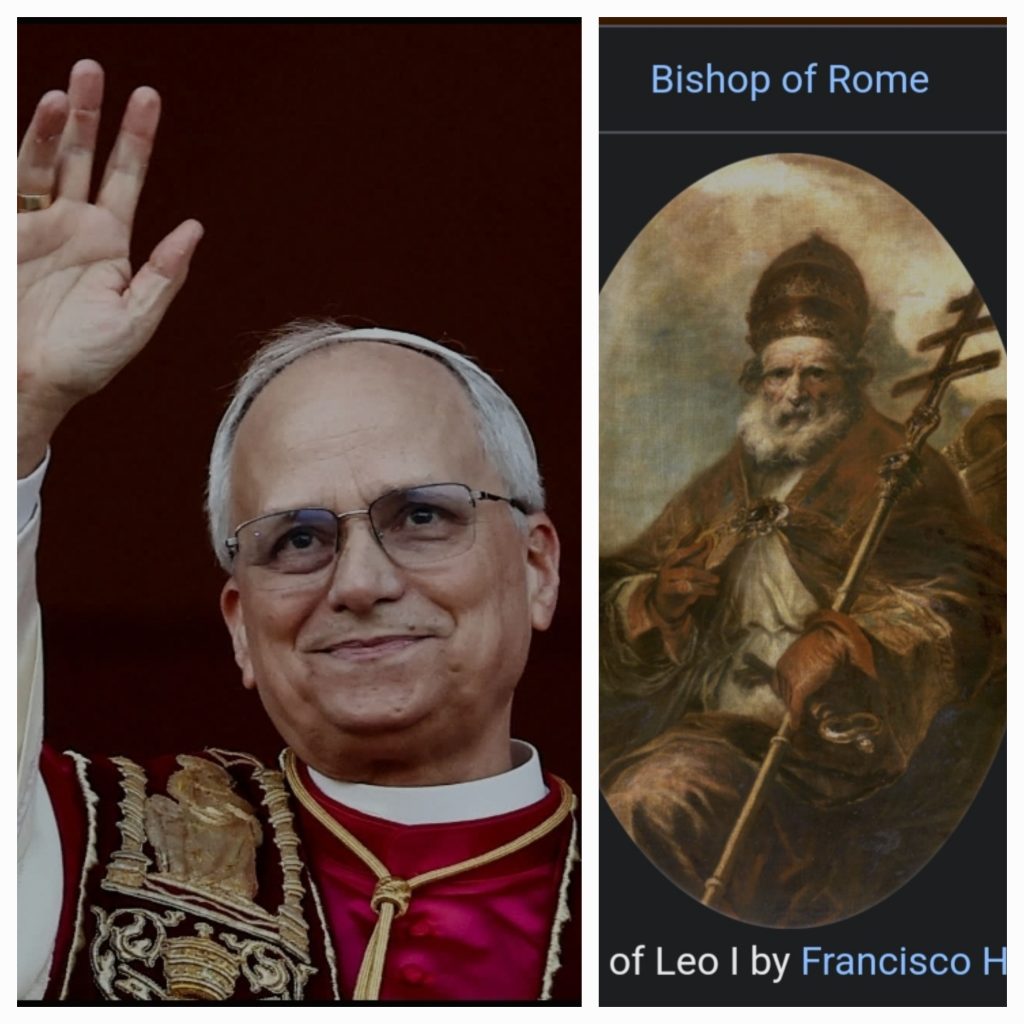
Many new popes choose to take on themselves name titles of prominent predecessors. Unlike the immediate past one, who simply took the name ‘Francis’, the newly elected pope has joined the tall list of those with roman numerals attached to their names.

The latest Pope with the name ‘Pope Leo XIV’ tells the story of 13 other papacy leaders with the same name. It’s not out of place to assume a particular name title is selected among many to reflect the inspirations and ideology of the new pope.
Before we get to know why he preferred ‘Pope Leo’, let’s take a memory lane down to brief history of those who first took the title, starting from ‘Pope Leo I to Pope Leo XIII and that may give a little clue about the inspiration of Pope Leo XIV. Based on historical account, I believe the new pope’s inspiration comes from the first ever Pope Leo and the last one-Pope Leo XIII.
Pope Leo I

Pope Leo I, also known as Leo the Great, was Bishop of Rome from 29 September 440 until his death. He is the first of the three Popes listed in the Annuario Pontificio with the title "the Great", alongside Popes Gregory I and Nicholas I.He is perhaps, best known for persuading against the invasion of Italy in 452.
Pope Leo II
Pope Leo II was the Bishop of Rome from 17 August 682 to his death. He is described by a contemporary biographer as both just and learned. He is commemorated as a saint in the Roman Martyrology. He was also noted for his charity to the poor. Pope from 682 august 17 to 683 June 28
Pope Leo III
Leo III the Isaurian also known as the Syrian, was the first Byzantine emperor of the Isaurian dynasty from 717 until his death in 741. His native tongue was Arabic or Syriac. He was pope from 795 to 12 June 816. He successfully defended Constantinople against Arab invaders as an emperor in 718
Pope Leo IV
Pope Leo IV was the bishop of Rome and ruler of the Papal States from 10 April 847 to his death in 855. He is remembered for repairing Roman churches that had been damaged during the Arab raid against Rome, and for building the Leonine Wall around Vatican Hill to protect the city.
Pope Leo V
Pope Leo V was pope immediately before the period known as the saeculum obscurum or the period of anarchy in the reign and election of popes. His papacy occurred in the second half of 903, with exact months being difficult to discern marked by controversy and power struggle
Pope Leo VI
Pope Leo VI was pope for just over seven months, from June 928 to his death in Feb. 929. His papacy was within the anarchy period as well.
Pope Leo VII
Pope Leo VII resigned within 3 years. He was not really interested in papacy but was forced to accept by a ruler of Rome to do his bidding. He was Pope from 3 January 936 to July 1, 939
Pope Leo VIII
Pope Leo VIII was a Roman prelate who claimed the Holy See from 963 until 964 in opposition to John XII and Benedict V and again from 23 June 964 to his death. Today, he is considered by the Catholic Church to have been an antipope during the first period and the legitimate Pope during the second. 6 December 963 (as antipope); 23 June 964 (as pope). He first declared himself a pope in 963 as opposed to two other popes before legitimately becoming a pope in 964, June 23.
Pope Leo IX
Pope Leo IX initiated several reforms in the middle age and focussed attention of the church in Easten Europe. He was pope from 1049-1054
Pope Leo X
Pope Leo X was head of the Catholic Church and ruler of the Papal States from 9 March 1513 to his death, in December 1521. He was crowned pope on 19 March 1513 at the age of 37. He was the last non-priest to be elected pope.
Pope Leo XI
Pope Leo XI, was pope from 1 April 1605 to his death, on 27 April 1605. His pontificate is one of the briefest in history, having lasted under a month.
Pope Leo XII
Pope Leo XII was pope from 28 September 1823 to his death in February 1829. Leo XII was in ill health from the time of his election to the papacy to his death less than 6 years later. He was noted for enduring pain well.
Pope Leo XIII

Pope Leo XIII became pope from 20 February 1878 until his death in July 1903. He had the fourth-longest reign of any pope, behind those of Peter the Apostle, Pius IX and John Paul II.
He is well known for his intellectualism and his attempts to define the position of the Catholic Church with regard to modern thinking. he became popularly titled as the "Social Pope" and the "Pope of the Workers".