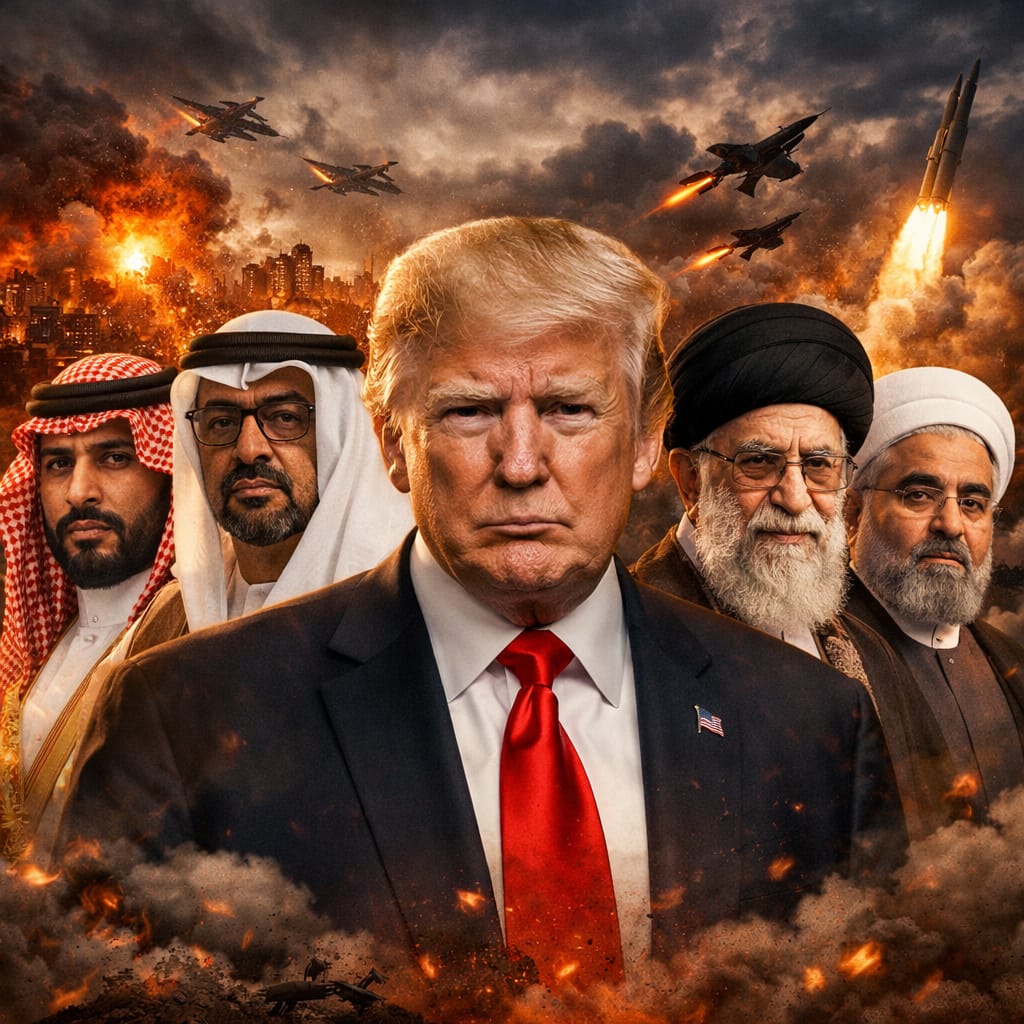
Neither the U.S. nor Israel Alone Is Driving the Iran War; Several Muslim Countries Are Quietly Behind It
The recent direct military confrontation between Israel and Iran has often been portrayed as a simple battle between two long-time enemies. Others see it as another chapter in the decades-long rivalry between the United States and Iran.
However, I believe that explanation is incomplete.
The more important question is not who fired the first missile, but why Israel and the United States felt able to confront Iran directly after decades of restraint.
In my view, the answer lies not only in military calculations but also in a major shift in regional politics. The biggest supporters of military pressure on Iran may not be Western countries at all. Rather, they are several Muslim-majority states that increasingly see Iran—not Israel—as their greatest long-term security threat.
Why Previous Arab-Israeli Wars Were Different
Since the establishment of the modern State of Israel in 1948, wars involving Israel and its Arab neighbors have often taken on a broader regional and religious dimension.
Some of the major conflicts include:
- 1948 Arab-Israeli War: Israel fought a coalition that included Egypt, Jordan, Syria, Iraq and Lebanon.
- 1967 Six-Day War: Israel fought Egypt, Jordan and Syria.
- 1973 Yom Kippur War: Egypt and Syria launched a coordinated attack against Israel.
For decades, Israel expected that conflict with one Arab state could quickly draw in others. This shaped Israeli military planning and encouraged it to maintain overwhelming military superiority.
Iran Changed the Regional Equation
Unlike the earlier Arab-Israeli conflicts, today's Middle East is divided by more than national interests. It is also shaped by ideological and sectarian competition.
Since the 1979 Islamic Revolution, Iran has sought to expand its regional influence through alliances with governments and armed groups that share its strategic objectives. While Iran sees itself as a leading force against Israel and Western influence, many Sunni-majority governments do not accept Iran's claim to regional leadership.
Instead, they increasingly view Tehran as a rival power seeking greater influence across the Middle East.
Why Israel and the United States Avoided Direct War for So Long
For many years, successive U.S. administrations and Israeli governments avoided launching a direct war against Iran.
This was not necessarily because Iran possessed a stronger conventional military.
Rather, a direct conflict carried enormous risks.
Military planners understood that an attack on Iran could ignite a much wider regional conflict involving Iranian-backed armed groups, disrupt global energy supplies, threaten U.S. forces stationed throughout the Gulf and potentially draw numerous countries into a prolonged war.
Avoiding those consequences became a major strategic objective.
Why the Situation Is Different Today
In recent years, relations between Iran and several Gulf Arab states have become increasingly strained.
Many of these governments accuse Iran of supporting armed groups operating across the region, including Hezbollah in Lebanon, the Houthi movement in Yemen and various militias in Iraq.
From their perspective, Iran is no longer simply challenging Israel. It is also challenging the security and stability of Arab governments.
As a result, the strategic interests of several Sunni-majority states have gradually shifted.
While these countries continue to publicly support the Palestinian cause and regularly criticize Israeli military actions, many also see a nuclear-armed Iran as an even greater long-term threat to regional stability.
The Gulf States' Security Calculations
The Gulf monarchies are geographically much smaller than Iran and possess significantly smaller citizen populations.
Recognizing this imbalance, many have relied heavily on security partnerships with the United States for decades.
American military bases, joint defence agreements and intelligence cooperation throughout the Gulf are not directed only at protecting Israel. They also serve as deterrence against potential Iranian aggression.
Several Gulf governments have publicly stated that Iran should not acquire nuclear weapons because they believe such an outcome would fundamentally alter the regional balance of power.
Public Opposition, Private Interests
Officially, nearly every Muslim-majority government has called for restraint and diplomacy.
Diplomatically, that position is understandable.
However, governments often distinguish between what they publicly declare and what quietly serves their national interests.
It is therefore reasonable to argue that some Sunni-majority governments may privately welcome efforts that weaken Iran's military capabilities, even while publicly condemning military escalation.
This does not necessarily mean they openly support war.
It means that the strategic outcome of a weaker Iran may align with their own security interests.
An Indirect Coalition
In my opinion, Israel and the United States did not decide to confront Iran in isolation.
They likely understood that many influential Arab governments would not intervene militarily on Iran's behalf.
That regional reality significantly reduced the risk that the conflict would evolve into a united Islamic military response similar to previous Arab-Israeli wars.
In that sense, the current conflict is not simply Israel versus Iran.
It is more accurately a conflict in which Israel and the United States are acting against Iran while several Muslim-majority states quietly benefit from the outcome without becoming direct participants.
Why Iran's Regional Relationships Matter
Iran has repeatedly accused certain Gulf governments of cooperating too closely with the United States.
Likewise, some Gulf states have accused Iran of interfering in their internal affairs through proxy groups and regional influence.
These mutual suspicions help explain why trust between Iran and many of its Arab neighbors remains limited despite their shared religion.
Religion alone has not been enough to overcome competing national interests.
Conclusion
The common narrative portrays this as a war between Israel and Iran.
I believe the reality is more complex.
Israel and the United States may be carrying out the military operations, but the broader geopolitical environment has been shaped by the strategic calculations of several Muslim-majority countries that increasingly regard Iran as a greater long-term threat than Israel.
Whether one agrees with that assessment or not, it helps explain why the conflict has not produced the united Islamic military response that many observers might once have expected.
Opinion: This article reflects the author's geopolitical analysis and interpretation of regional developments. It distinguishes opinion from established facts and encourages readers to consider alternative viewpoints supported by credible evidence.