Introduction
Ovulation is one of the four important cyclical changes that occur during the menstrual cycle in females after puberty. One does not need to be a healthcare professional to understand the basic scientific facts about the human body. Acquiring accurate knowledge about one's health empowers individuals to make informed decisions and adopt healthier lifestyles.
Maintaining good health is a shared responsibility. While healthcare professionals provide expert guidance, every individual also has a role to play in protecting and promoting their own health through informed choices and appropriate healthcare-seeking behaviour.
With this in mind, let us take a simplified, factual look at ovulation and its role in the menstrual cycle. Understanding ovulation can help both women and their partners who wish to achieve a natural pregnancy, as well as those seeking to understand fertility and natural family planning methods.
What Is Ovulation?
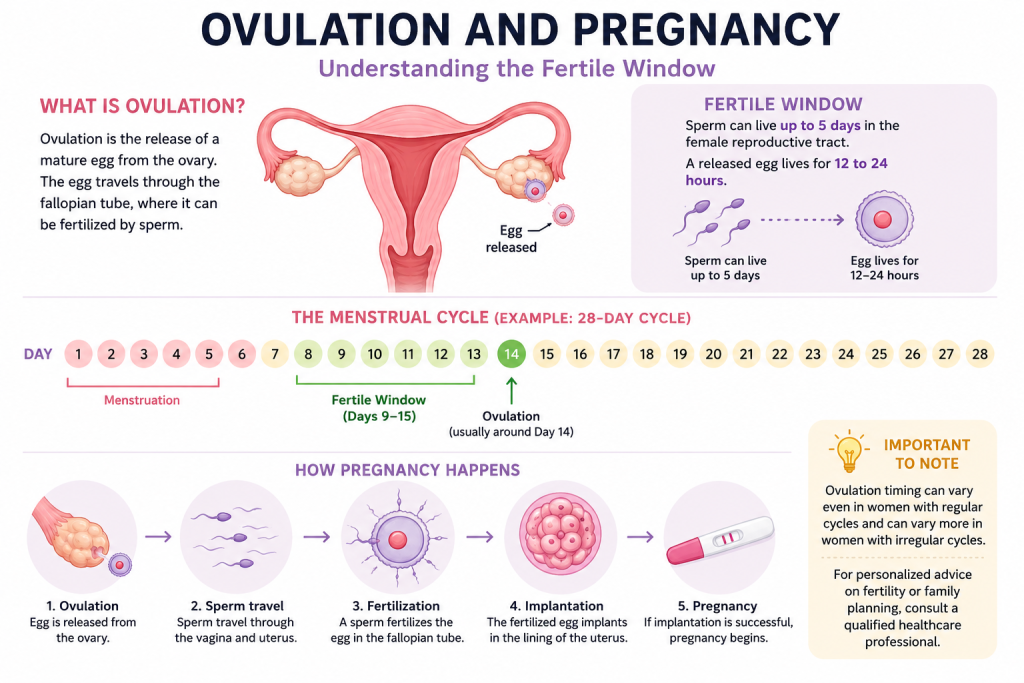
Ovulation is the process by which a mature egg is released from one of the ovaries. Once released, the egg travels into the fallopian tube, where it may be fertilized by a sperm if unprotected sexual intercourse has occurred during the fertile period.
A released egg remains viable for fertilization for about 12 to 24 hours, while sperm can survive in the female reproductive tract for up to five days under favourable conditions. Therefore, if a woman has unprotected sexual intercourse during the five days before ovulation or on the day of ovulation, pregnancy can occur.
Fertile Window in a 28-Day Menstrual Cycle
For women with a regular 28-day menstrual cycle, ovulation often occurs around Day 14, although this may vary from person to person. In such a cycle, the fertile window generally spans from about Day 9 to Day 15. During this period, unprotected sexual intercourse carries the highest likelihood of pregnancy.
Does This Apply to Every Woman?
It is important to note that this method of estimating ovulation is most useful for women with regular menstrual cycles. It is much less reliable for women with irregular menstrual cycles, where the timing of ovulation can vary significantly from month to month.
For example, a woman's menstrual cycle may last 27 days one month and 29 days the next, making it difficult to accurately predict ovulation using calendar calculations alone. Even among women with regular cycles, ovulation may not occur on exactly the same day every month.
Signs That a Woman May Be Ovulating
Although ovulation may not produce noticeable symptoms in every woman, some women experience one or more of the following signs:
- Clear, slippery and stretchy vaginal discharge that resembles raw egg white.
- Mild pain or discomfort on one side of the lower abdomen (ovulation pain or mittelschmerz).
- Increased sexual desire (libido).
- Slight rise in basal body temperature after ovulation.
- Mild breast tenderness or soreness.
- The cervix may become softer, higher and more open during the fertile period.
It is important to note that not every woman experiences these signs, and their presence does not guarantee that ovulation has occurred. Likewise, the absence of these signs does not necessarily mean that ovulation did not occur. Women with concerns about ovulation, fertility or irregular menstrual cycles should consult a qualified healthcare professional for proper assessment.
Important Advice
Anyone wishing to avoid pregnancy should not rely solely on the calendar method without receiving appropriate counselling from a qualified healthcare professional. Likewise, couples trying to conceive may benefit from understanding the fertile window and discussing fertility concerns with a healthcare provider if pregnancy does not occur after a reasonable period of trying.
Understanding ovulation also enables individuals and couples to make informed reproductive health decisions, seek medical attention early when necessary, and appreciate the importance of maintaining good reproductive health.
Key Takeaways
- Ovulation is the release of a mature egg from an ovary.
- A released egg remains viable for fertilization for approximately 12–24 hours.
- Sperm can survive in the female reproductive tract for up to five days.
- The fertile window is the period during which pregnancy is most likely to occur.
- In women with a regular 28-day menstrual cycle, ovulation often occurs around Day 14, but this can vary.
- Calendar calculations are less reliable for women with irregular menstrual cycles.
- Couples trying to conceive or avoid pregnancy should seek professional guidance when using fertility awareness methods.
Watch the videos below to learn more.
People are reading these; click on links below to see more:
Can you get pregnant while on your period?
Family planning in Ghana; practical experience in health facility
Why you must keep NHIS even if you are rich
Disclaimer: This article is for public health education only and does not replace professional medical advice, diagnosis, or treatment. Please consult a qualified healthcare professional for personalized medical care and reproductive health guidance.